How AI Powers Facial Recognition Technology
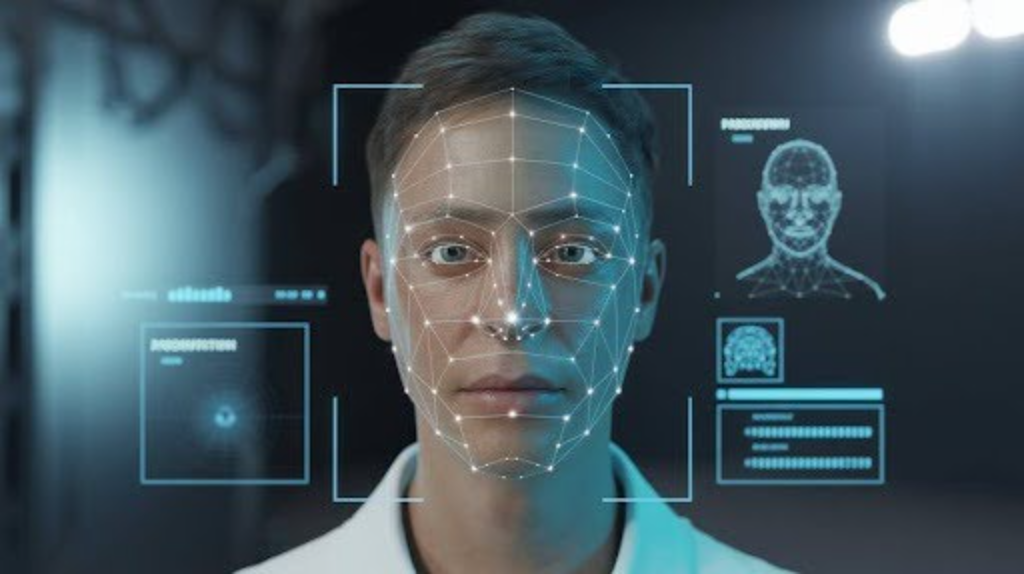
Facial recognition technology has become increasingly common across consumer, travel, and identity-verification applications, making it a growing part of everyday life for Americans. It’s a feature that started out as a specialty security solution and has now become a part of phones, airports, retail stores, and financial applications across the United States. Whilst this has provided convenience, it has also raised more serious issues for businesses, legislators, and users of the technology about how accurate, how consensual, and where the boundaries of such technology should be drawn.
How Facial Recognition Technology Works
Facial recognition systems perform four stages to turn a photo or video frame into an identity match.
Face detection comes first. The system scans an image to locate where a face is, drawing a bounding box around it and ignoring background clutter. Modern systems typically use convolutional neural networks trained on large sets of labeled images to do this reliably across different angles, lighting and partial occlusions like glasses or masks.
Once the system locates a face, feature extraction identifies distinguishing landmarks, points like the corners of the eyes, the bridge of the nose, and the contours of the jawline, and measures the geometric relationships between them. A neural network converts these measurements into a compact numerical representation of the face.
That numerical representation is the biometric template, sometimes called a faceprint. It is not a photo. It is a string of numbers, typically a vector with hundreds of values, that encodes the face’s distinguishing features in a form that systems can store and compare but cannot reverse back into the original image.
The final stage is similarity scoring. When the system needs to verify or identify a new face, it generates a fresh template from the live image and compares it mathematically against one or more stored templates, most often using cosine similarity or Euclidean distance. If the resulting score clears a preset threshold, the system returns a match. That threshold is a deliberate trade-off: setting it too loose increases false positive matches, and setting it too strict increases false rejections of genuine users.
What’s Facial Recognition Doing Today?
More than many people think, facial recognition is already involved in aspects of daily life. Smartphone unlocking was an early, low-stakes use case, but in recent years has become far more deeply entrenched in higher-stakes contexts, such as financial account authentication, workplace access control, and international border travel document verification. The majority of consumers have had some kind of experience with facial recognition technology, even if they didn’t realize it was what they were using. Part of that awareness gap is also the larger discussion, and many people may be using the technology in a public or commercial context where they don’t know when and how their picture is being used.
Which Industries Are Going to Adopt Facial Recognition Technology?
Financial services, travel, and retail are among the industries adopting facial recognition fastest, though each applies it for different reasons. In travel, the Transportation Security Administration’s PreCheck Touchless ID program is expanding to 65 airports this spring, letting enrolled travelers clear security without presenting a physical ID. In financial services, regulatory obligation drives adoption more than convenience does. Banks must maintain a Customer Identification Program under the USA PATRIOT Act, and the Financial Crimes Enforcement Network (FinCEN) has acknowledged that new biometric verification tools now support that requirement without a branch visit. Retail carries more governance risk than either. The Federal Trade Commission (FTC) found that Rite Aid deployed facial recognition in hundreds of stores from 2012 to 2020 without testing its accuracy, disproportionately misidentifying Black, Asian, Latino, and women shoppers as suspected shoplifters. The resulting five-year ban on Rite Aid’s use of the technology for security purposes has become a reference point for regulators assessing whether retailers’ loss-prevention systems include adequate accuracy testing and bias mitigation.
What Are the Current Limitations of Facial Recognition Software?
Despite significant improvements, facial recognition systems remain vulnerable to poor image quality, presentation attacks, synthetic media, and operational errors.
Accuracy also depends heavily on environmental and demographic variables. The National Institute of Standards and Technology (NIST) evaluated nearly 200 face recognition algorithms from around 100 developers against more than 18 million images of over 8 million people through its Face Recognition Vendor Test, and found that most of the algorithms tested showed a wide range of accuracy across demographic groups defined by age, sex, and race. Lighting conditions and camera quality compound these effects further. This variability is partly why regulators and civil liberties groups have advocated for accuracy and transparency testing before organizations deploy facial recognition software in meaningful contexts such as law enforcement or hiring.
What is the Deepfake Real Challenge
Generative AI introduces influential challenges in the realm of visual media. With advancements in technology, creating videos and images that appear authentic can now be achieved on a scale unimaginable just a few years ago. This capability raises serious concerns about the integrity of visual content, making it increasingly difficult for viewers to discern whether a face captured on camera truly belongs to a real individual or if it has been artificially generated or manipulated. As a result, the proliferation of deepfakes and similar technologies complicates the verification process, posing risks not only to personal privacy but also to social trust and the accuracy of information in an age when visual evidence is often taken at face value.
What Is the Future of AI Facial Recognition and Detection?
This pressure has led AI facial recognition systems to develop more advanced models than those of previous generations. These are meant to not only match static images but, more importantly, subtle motion, depth, and texture cues that are hard to get right, especially when combined with dedicated liveness detection layers, and are increasingly being applied in newer systems.
This has led to facial recognition technology becoming an arms race. With the development of ever-better AI facial recognition systems, the tools for creating synthetic faces are improving as well, making it impossible for facial recognition providers to simply invest once and forget. Leveraging fraud technology that is constantly updated to address new forms of fraud is now a standard practice of serious providers. Successful providers regularly update their fraud technology to address new fraud techniques.
How Are Regulators Responding to Facial Recognition Systems?
Several states in the US have enacted or proposed legislation that specifically governs the collection, storage, and use of biometric data by facial recognition systems. Many of these laws also apply when facial recognition is used for age verification, requiring organizations to handle biometric information responsibly and, in some cases, obtain explicit written consent before processing an individual’s image. One of the most frequently referenced examples is Illinois’ Biometric Information Privacy Act (BIPA), which has led to numerous lawsuits and settlements against companies found to have collected biometric information without proper consent. As AI-powered age verification becomes more widely adopted across online platforms and regulated industries, compliance with biometric privacy laws is becoming increasingly important.
Why Is Compliance So Complicated for Facial Recognition Systems?
Due to a lack of any single federal facial recognition legislation, businesses with a facial recognition solution that is used in multiple states are subject to a variety of different requirements. For any company that is considering going nationwide, this has turned compliance strategy into a business decision, rather than a legal one. Some companies have reacted by putting the most stringent standard in place that they are able to, just to avoid having to run several compliance regimes simultaneously.
What Is the Future of Facial Recognition Technology?
Facial recognition technology will continue to grow as AI improves accuracy, speed, and fraud detection. At the same time, advances in deepfakes and synthetic identities will keep raising the bar for verification systems. The future will depend on more than better algorithms; it will require stronger privacy protections, transparent testing, and regulations that balance innovation with public trust.
For businesses, adopting facial recognition is no longer just a technology decision. Success depends on choosing solutions that combine reliable identity verification, continuous security updates, and compliance with changing biometric privacy laws. As AI reshapes digital identity, the systems that earn trust will be those that show both accuracy and accountability.












Kommentar abschicken